
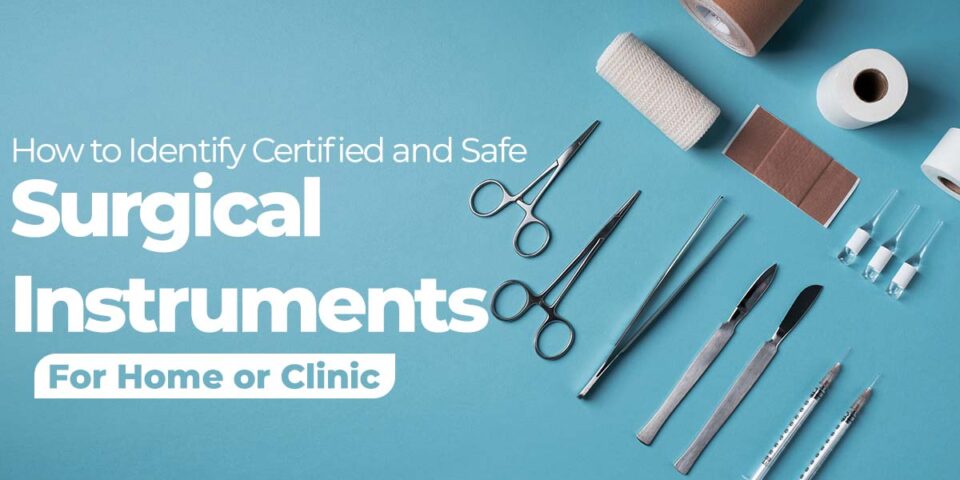
How to Identify Certified and Safe Surgical Instruments for Home or Clinic
What was earlier restricted to hospitals has become routine equipment for outpatient and home-based care. Smaller medical units and even home nurses rely on instruments that earlier belonged strictly to surgical departments. This wider access has made minor procedures and post-operative care more efficient, but it has also increased the risk of unregulated or poorly made instruments entering the market. Choosing products from verified Surgical Instruments Suppliers has therefore become essential.
When instruments come from uncertain sources or use poor-quality steel, trouble follows sooner or later. A clamp that doesn’t lock properly or a scalpel that dulls too quickly can cause injury or infection long before anyone realizes what went wrong. That’s why buyers now spend more time checking where each piece was made, who approved it, and how it’s documented. Traceability, certification papers, and a known supplier record have become part of basic safety practice, not extra paperwork. In today’s healthcare setting, whether in a large hospital or a small clinic, those checks are what keep both staff and patients protected.
Understanding Certification Standards for Surgical Instruments
Instruments used in surgery or patient care can’t just look right; they have to be cleared through specific regulatory steps before they’re sold. In India, this responsibility sits with the Central Drugs Standard Control Organization (CDSCO), which checks how each device is made and what risk it carries when used on the body. Once approved, the maker follows the same control process defined in BIS or ISO 13485. Imported pieces are checked again to confirm the batch history and testing record.
Whether the buyer runs a clinic or keeps medical equipment for home use, confirming these details is part of basic healthcare product safety. At R L Hansraj & Co., we keep files open for inspection so customers can confirm they’re receiving truly Certified Surgical Instruments.
Key Physical Indicators of a Safe Surgical Instrument
People working with instruments every day can usually tell, at a glance, whether a tool is built right. The surface gives away the first clue. A genuine, Certified Surgical Instrument will have a uniform, fine-grained finish that feels smooth but not glossy. Any rough patch, sharp edge, or small crack can hold residue and compromise sterility.
When you pick up the instrument, the metal usually tells you its story. Good ones, the ones made from proper surgical steel, say grades like AISI 410 or 420, stay solid even after long cycles of heat and cleaning. They don’t twist or change colour. Cheaper metals behave differently. After a few rounds in the autoclave, you’ll start seeing faint rust near the hinge or a blade that doesn’t sit right anymore. That’s the moment you know it isn’t built for repeated use.
Weight and balance matter more than most realize. A well-made instrument sits naturally in hand, not too heavy, not too light. The hinge should move cleanly without wobble or drag. Markings are equally important: a proper instrument carries the maker’s name, batch number, and reference to its manufacturing standard. These are not mere stamps; they trace accountability. The physical signs are checked at R L Hansraj and Co. prior to the unit coming out of the workshop, and the result of this is the assurance of the ultimate safety of healthcare products in the hospitals, as well as home medical equipment.
Importance of Material and Sterilization Compatibility
When you handle surgical tools often, you start noticing how the metal behaves after cleaning. The good ones, Certified Surgical Instruments made from medical-grade steel or titanium, stay steady through years of sterilization. They don’t change colour or lose grip. Cheaper ones react fast; after a few heat cycles, the surface turns cloudy or the hinge begins to tighten. Those small signs usually tell you the mix of metal was never right.
For clinics or medical equipment for home use, it’s safer to read the label and follow it exactly. If it says single-use, treat it that way. Tools that can’t go through autoclaving should never be shared. At R L Hansraj & Co., each piece is marked for its sterilization method, and test reports are kept with the batch. That discipline is what protects real healthcare product safety, not just the paperwork.
Common Red Flags: How to Spot Uncertified or Unsafe Instruments
You can usually spot a poor-quality tool if you look closely. Labels missing the maker’s name or printed with small spelling errors are an early warning. Phrases like “surgical grade” without any listed standard mean nothing. True stainless steel instruments don’t show up at unusually low prices. If the cost looks too good, it probably reflects the metal. Rust stains, loose hinges, and sharp unfinished edges confirm that the batch was never tested. Packaging that lacks clear sterilization proof, such as “ETO Sterilized” or “Gamma Sterilized,” should be left aside. Reputed Surgical Supplier in Bangalore, like us, always provides traceable documents and consistent markings so buyers know what they are getting.
Why Choose Certified Surgical Instruments from R L Hansraj & Co.
For more than sixty years, people in hospitals and clinics have turned to R L Hansraj & Co. when they need tools they can trust. The company doesn’t just resell boxes; it checks every scalpel, clamp, and diagnostic piece before it goes out. Most of that inspection happens at the Chennai office, where records and test notes are kept for traceability. Over time, that process has become their routine, not a formality. Among Surgical Equipment Manufacturers in Chennai, the firm stands out for staying consistent with what it promises: instruments that hold shape, stay sterile, and perform exactly as the user expects.