
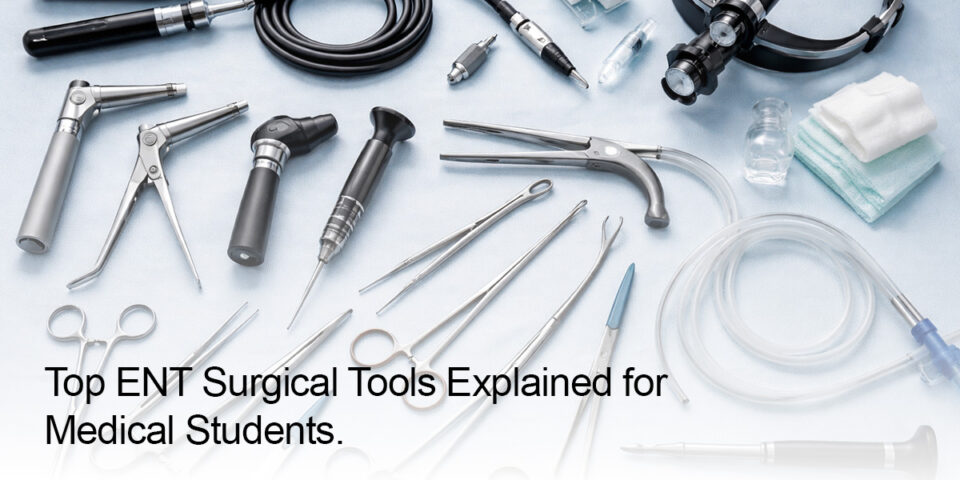
ENT surgery is a discipline defined by a lack of room. You are essentially operating within dark, narrow, and incredibly vascularized corridors where a single millimeter of deviation feels like a mile. This isn’t a textbook exercise; it’s a high-stakes environment where the quality of your steel dictates the success of your reach. While many students focus on memorizing flashcards for exams, the transition to the OR requires a deeper understanding of why ergonomic balance and specialized steel are non-negotiable. Whether you are handling delicate ophthalmic surgical instruments or robust ENT forceps, the tactile feedback of the tool is what prevents tissue trauma. R.L. Hansraj & Company has been the quiet partner in medical colleges for decades, providing the very first sets of instruments that many surgeons have ever held in their hands. We believe that a student’s first tool should carry the same precision as a senior consultant’s, ensuring that your early training is built on a foundation of absolute reliability.
Otology: Navigating the Middle Ear
Otology is where the margin for error effectively disappears. When you are performing a stapedectomy or a tympanoplasty, you are working in a space smaller than a fingernail, often under a high-power microscope. The surgical tools used here are not just smaller versions of standard equipment; they are marvels of micro-engineering. Take the Micro-alligator forceps, for instance. These ENT surgical tools must offer a “zero-play” hinge mechanism so that the tips meet with absolute symmetry, allowing you to grasp a microscopic graft or a displaced ossicle without the instrument stuttering or slipping.
A critical “student tip” that you won’t find in a generic catalog involves the haptic feedback of your ENT tools. The weight and “feel” of a micro-pick or probe are your primary sensory inputs when your vision is obstructed by a drop of blood or a narrow canal. If an instrument is too heavy or poorly balanced, it can dampen your sensitivity, leading to accidental trauma to the ossicular chain. Using a probe with the correct ergonomic weighting allows you to feel the subtle resistance of the stapes before you inadvertently cause permanent hearing loss. Precision in this field is as much about what you feel as what you see.
Rhinology: Beyond the Speculum
Modern rhinology has undergone a massive shift from external approaches to the high-definition world of Functional Endoscopic Sinus Surgery (FESS). As a student, you’ll quickly realize that navigating the paranasal sinuses requires ENT surgical tools that act as an extension of your eyes. The Sickle Knife is often the first tool you’ll reach for to make precise mucosal incisions around the uncinate process. Because space is at a premium, the sharpness of that blade is everything; a dull edge won’t cut, it will simply drag and bruise the delicate lining.
Once you begin the actual dissection, Blakesley Forceps become your workhorse. These ENT tools are designed to “bite” and remove bone or tissue without obscuring your endoscopic view. The operational reality here is unforgiving: if the forceps have lost their “bite” precision through poor manufacturing or wear, they will tear the mucosa rather than shear it cleanly. This tearing leads to unnecessary bleeding, which can blind your field of vision in seconds. Professional-grade rhinology instruments aren’t just about the shape; they’re about the metallurgical integrity that ensures every movement results in a clean, predictable incision.
Laryngology and Head & Neck: Access and Control
Laryngology presents a unique mechanical challenge, requiring you to bridge the gap between “macro” neck dissections and “micro” vocal cord surgeries. Your primary goal is creating a stable, wide-open workspace in a very restricted area. This is where surgical tools like the Boyle-Davis mouth gag become essential; they provide the reliable retraction needed to keep the oral cavity accessible without slipping or causing dental trauma.
When you transition to working on the larynx itself, a Direct Laryngoscope becomes your primary conduit. However, a technical nuance often overlooked by beginners is the finish of these ENT surgical tools. If you are operating under a high-intensity surgical microscope, a polished, shiny tool is your enemy. You need instruments with a “non-reflective” or matte finish to prevent blinding glare from the light source. Without this specialized coating, the reflection can obscure the subtle texture of the vocal folds, making it nearly impossible to distinguish between healthy tissue and a micro-lesion. Control in laryngology is as much about managing light as it is about managing tissue.
Quality and Materiality: Why Not All Steel is Equal
Metallurgy might feel like a dry subject for a lecture hall, but in the OR, it’s the difference between a clean incision and a jagged, traumatized edge. Not all ENT surgery instruments are built from the same stock. Most students don’t realize that the 300-series stainless steel used for your retractors is chosen for corrosion resistance, not sharpness. It’s the 400-series “martensitic” steel you really need to watch for; that’s the carbon-heavy grade that allows a sickle knife or a pair of iris scissors to hold a razor edge without rolling or dulling mid-procedure. If your cutting tools feel “mushy,” you’re likely fighting poor-grade steel.
Beyond the raw materials, you have to look for the literal stamps of accountability. Before you even think about bringing a tool into a sterile field, check for the ISO 9001:2015 and BIS markers. These aren’t just redundant badges; they are the only proof you have that the instrument won’t snap under tension or seize up during a critical manipulation. A tool without these certifications is a gamble you shouldn’t be willing to take with a patient on the table.
Conclusion
Mastering the technical nuances of ENT surgery is a lifelong pursuit, but your success starts with the steel in your hand. An instrument isn’t just a piece of hardware; it is a literal extension of your tactile sense and surgical skill. Settling for generic, unverified tools from a random surgical shop in Coimbatore might save a few rupees today, but it sacrifices the “predictability” you need during a high-stakes procedure. You want a tool that behaves exactly the same way every time you pick it up, no surprises, no “play” in the hinges, and no unexpected dullness.
R.L. Hansraj & Company provides that level of certainty through 98 years of specialized manufacturing experience. We have spent nearly a century refining the balance and metallurgical integrity of our instruments so that you can focus entirely on the patient, not the equipment. Every resident deserves a kit that supports their growth rather than hindering it with mechanical failure. We encourage you to explore our current catalog for both student-grade starter sets and our professional-tier instrumentation. Invest in tools that are as committed to precision as you are.