
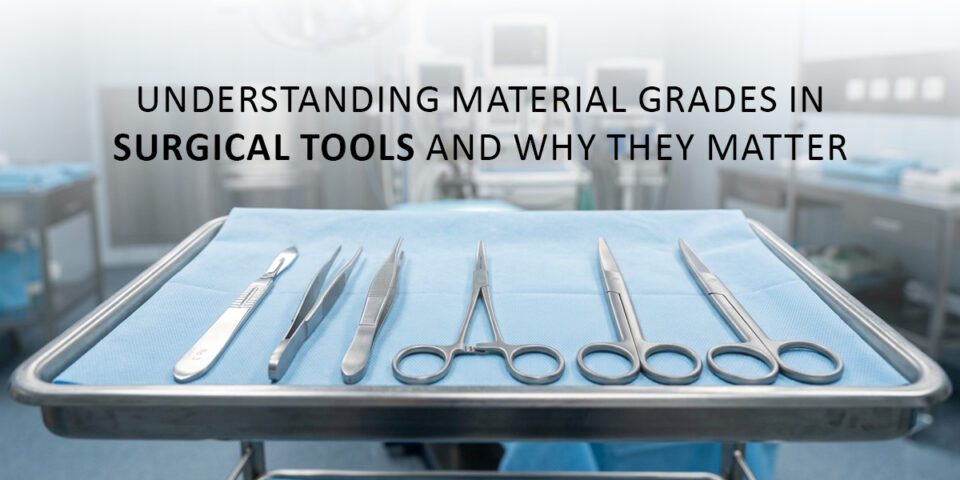
When a surgeon picks up a scalpel or a pair of forceps, the last thing on their mind should be whether the instrument will hold up. That confidence comes from the material the tool is made from, and not all materials are created equal. Surgical tools used in clinical and hospital settings go through repeated sterilisation cycles, exposure to bodily fluids, and the mechanical stress of precision work. The grade of material determines how well an instrument handles all of that over its working life. For hospitals, clinics, and procurement teams evaluating Medical Tools for Surgery, understanding material grades is not a technical detail. It is a purchasing decision that directly affects patient safety and instrument longevity.
Why Material Grade Matters in Surgical Instruments
Most surgical instruments are made from some form of stainless steel, but “stainless steel” covers a wide range of alloys with very different properties. The grade determines:
- Corrosion resistance: How well the instrument withstands repeated autoclaving, chemical disinfectants, and exposure to saline or blood
- Hardness and edge retention: Whether cutting instruments stay sharp through repeated use or dull quickly
- Tensile strength: How much mechanical stress the instrument can take before deforming
- Biocompatibility: Whether the material is safe for contact with tissue and body fluids without triggering reactions
- Surface finish quality: Whether the instrument can be polished to a level that resists bacterial adhesion
A lower-grade material may look identical to a premium one straight out of the packaging. The difference shows over time: in rust spots, in instruments that lose their edge after a few procedures, or in tools that develop micro-fractures under sterilisation stress.
The Most Common Material Grades Used in Surgical Tools
316L Stainless Steel
Ask most instrument manufacturers what they use for high-contact, high-sterilization applications and 316L comes up every time. It is the go-to grade for Surgical Instrument Materials precisely because it holds up where others start showing problems. The “L” means low carbon, which matters during autoclaving. Lower carbon content reduces carbide precipitation at the grain boundaries and keeps the steel’s corrosion resistance intact after repeated high-temperature cycles.
What sets it apart in practice:
- Resists chloride corrosion better than most surgical-grade steels, relevant in saline-heavy environments
- Biocompatible enough to be used in implants, so instrument contact with tissue is not a concern
- Survives repeated steam sterilization at 134°C without surface breakdown
- The added molybdenum and nickel content (more than 304) gives it stronger resistance to pitting, which is where cheaper steels tend to fail first
Forceps, retractors, and general surgical scissors are instruments that go through dozens of sterilisation cycles a week. That is where 316L earns its cost premium.
410 and 420 Stainless Steel
These are martensitic stainless steels, harder and more capable of holding a sharp edge than austenitic grades like 316L, but with lower corrosion resistance.
- 410 is used where hardness is needed but edge retention is not critical, handles, box joints, and non-cutting components
- 420 is the standard for cutting instruments: scissors, scalpels, and needle holders that need to hold an edge through repeated sharpening and use
The trade-off with 420 is that it requires more careful handling and proper drying after sterilisation to prevent surface oxidation. Instruments made from 420 that are stored wet or in poorly ventilated trays will rust faster than 316L counterparts.
Tungsten Carbide
Tungsten carbide is not a steel alloy at all. It is a ceramic-metal composite, and it is substantially harder than any surgical-grade stainless steel. Most instruments described as “tungsten carbide” use it as an insert rather than as the full body material. The jaws of needle holders and scissors get a carbide face, which holds its edge far longer than the steel body around it.
Look for the gold-coloured handles. That is the standard industry identifier for instruments with carbide inserts. They cost more to buy. In a busy surgical unit running high procedure volumes, they tend to work out cheaper over time because resharpening intervals stretch out considerably compared to all-steel equivalents.
Titanium
Titanium instruments run roughly 45% lighter than steel equivalents. That sounds like a marginal difference until you are two hours into a procedure and your hand is starting to feel it.
The other reason titanium gets specified is the MRI suite. Steel instruments are ferromagnetic. Titanium is not. In any procedure where imaging is happening in real time, or in neurosurgical environments with strict magnetic field protocols, that is not optional. Titanium is the only viable choice.
The limitation worth knowing: titanium is softer than hardened steel grades. It does not hold a cutting edge well, so it stays in its lane: retractors, needle holders, and microsurgical tools, where precision grip matters more than sharpness.
How Material Grade Affects Sterilization Compatibility
This is where material choice has direct clinical implications. Different sterilisation methods interact differently with instrument materials:
- Steam autoclave (134°C): 316L and titanium handle this well. Lower-grade steels may show surface degradation over repeated cycles
- Chemical sterilants (glutaraldehyde, hydrogen peroxide): Corrosive to lower grades; 316L is significantly more resistant
- Dry heat sterilization: Generally compatible with all surgical-grade steels but can accelerate surface oxidation in 410/420 grades if instruments are not properly finished and maintained
Instruments that are not matched to their intended sterilisation method will degrade faster, creating both a procurement cost problem and a potential patient safety issue if surface integrity is compromised.
Surface Finish and Its Role in Surgical Instrument Materials
Material grade alone does not determine instrument quality; the surface finish applied to the base material matters significantly.
Three standard finishes are used across Medical Tools:
- Mirror polish: Highly reflective, smooth surface that resists bacterial adhesion and is easy to inspect for damage or contamination. Common in general surgical instruments
- Satin/matte finish: Reduces glare in the surgical field, making instruments easier to work with under bright theatre lighting. Standard in ophthalmic and microsurgical tools
- Black oxide/ebonite coating: Used on instruments in laser surgery environments to prevent reflective interference
A poor surface finish on a high-grade material will still result in a substandard instrument. Conversely, a well-executed polish on a premium-grade steel significantly extends working life and simplifies sterilisation compliance.
What to Look for When Sourcing Surgical Instruments
For procurement teams and clinical leads evaluating suppliers, a few practical checkpoints:
- Ask for material certification; reputable suppliers can provide mill certificates specifying the alloy grade
- Check for ISO certification on the manufacturer; ISO 9001:2015 covers quality management systems and indicates consistent production standards
- Examine finish quality closely on samples before committing to bulk orders, surface irregularities, rough joints, or inconsistent polish are indicators of lower production standards
- Verify sterilization compatibility against your facility’s specific sterilization protocols before procurement
- For high-use cutting instruments, tungsten carbide inserts are worth the premium in a high-volume surgical setting
Choosing the Right Instruments for the Right Procedure
Material grade decisions are not one-size-fits-all. A general surgery department running dozens of procedures daily has different requirements from a specialist ENT clinic or an ophthalmology unit. ENT Surgery Instruments, for example, often involve very fine, precision tools that work in confined anatomical spaces. The material and finish requirements for a nasal speculum or micro laryngeal instrument are different from those of a general retractor or clamp.
Understanding what each surgical tools application demands in terms of hardness, corrosion resistance, weight, and sterilisation compatibility. That is what separates a well-equipped surgical team from one that is constantly managing instrument failure mid-procedure. The material grade is where that performance either starts or falls apart.