
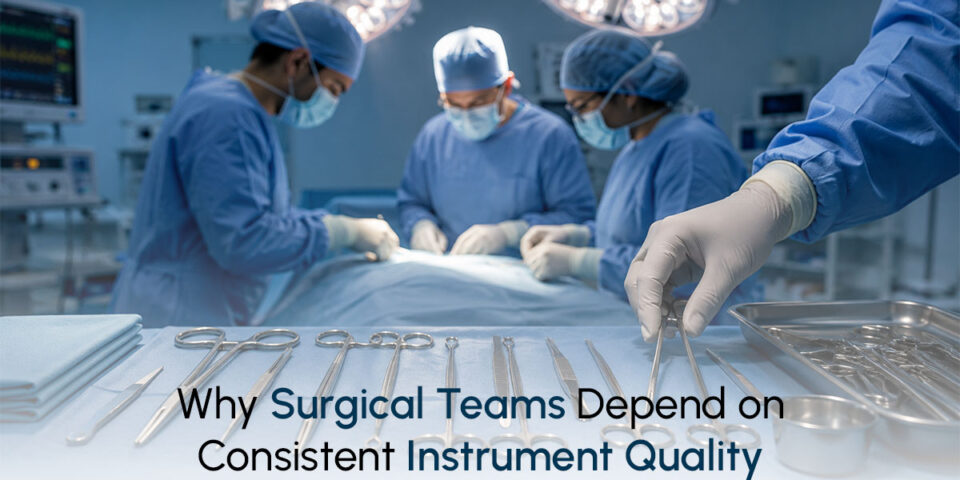
Walk into any operating room and you will notice something most patients never think about: the instruments on the tray have to behave exactly the same way every single time. A scalpel that feels slightly different in the hand, a forceps that grips a little looser than usual, or a retractor with uneven tension can throw off a surgeon’s rhythm mid procedure. That’s precisely why high quality surgical instruments aren’t a luxury item on a hospital’s checklist, they’re a baseline necessity. Trustworthy medical tools for surgery let surgical teams stay fully present with the patient rather than doubting the equipment they’re holding. In this blog, we will dig into why consistency in surgical instruments matters this much, and what separates the truly dependable tools from everything else on the tray.
The Hidden Cost of Inconsistent Tools
A lot of what happens in surgery comes down to muscle memory. A surgeon who has performed hundreds of procedures develops an instinct for how a clamp should close or how much resistance a needle holder should offer. When that feel changes from one set to another, even slightly, it disrupts focus. If instruments aren’t consistent, teams end up adjusting on the spot, and that costs time and raises the risk of something going wrong.
This is particularly true in high-volume hospitals where instruments go through repeated sterilization cycles. Cheaper tools often lose their precision after a handful of autoclave runs. Joints loosen. Cutting edges dull faster. Coatings wear off unevenly. None of this is visible from the outside, but surgical teams feel it the moment they pick up the instrument.
What Makes an Instrument Truly Reliable
Quality in surgical equipment is not about appearance.Quality in surgical equipment is not about appearance.It comes down to the grade of material used, how precisely the instrument is manufactured and how well it holds up under repeated stress over time. Surgical equipment manufacturers that follow strict quality protocols typically focus on a few non negotiables.
- Stainless steel built to surgical grade, so it doesn’t corrode even after going through sterilization again and again
- Joints and edges milled with real precision, holding their accuracy through hundreds of uses
- Ergonomics that actually reduce hand fatigue when an operation runs long
These details matter more than they seem. A tonsillectomy set, an orthopaedic clamp, or an ophthalmic forceps all serve very different purposes, but they share one demand: predictable performance, procedure after procedure.
Why Hospitals Cannot Afford to Compromise
Patient safety is directly tied to instrument reliability. A blunt scissor adds unnecessary tissue trauma. A misaligned forceps can slip at the wrong moment. These are not abstract risks, they show up in operating theatres every day when low-grade tools are used to cut costs.
Procurement teams sometimes treat surgical instruments as a line item to negotiate down. But professional surgical instruments are an investment in outcomes, not just an expense. Hospitals that standardize their supply chain around trusted manufacturers tend to see fewer instrument failures, fewer delays, and better consistency across departments and surgical specialties.
There is also a training dimension to this. Medical colleges and teaching hospitals need instruments that perform the same way for every student and resident learning a technique. If the tools vary in quality, the learning curve becomes distorted, and that affects how confidently new surgeons operate later in their careers.
Building a Dependable Supply Chain
Hospitals that get this right usually work with one or two trusted suppliers of medical and surgical equipment rather than sourcing opportunistically. This builds familiarity. Staff know what to expect from each set, sterilization teams know how the instruments respond to repeated cycles, and procurement can plan replacements before quality starts to slip rather than after a failure occurs mid-procedure.
Certification matters here too. Instruments tested against international quality benchmarks go through rigorous checks before they ever reach a tray, which gives surgical teams one less variable to worry about on an already demanding day.
A Closing Note from R.L. Hansraj & Co.
At R.L. Hansraj & Co., we have spent over nine decades supplying hospitals, clinics, and medical colleges across India with instruments built to perform the same way every single time. Our ISO 9001:2015 certification reflects a manufacturing discipline we do not compromise on, whether it is a general surgical set, an ENT tray, or specialized ophthalmic tools. As one of the trusted surgical instrument manufacturers in Chennai, we understand that surgical teams cannot afford uncertainty in their equipment and we build every instrument with that responsibility in mind. If your hospital or practice is looking for a supplier that treats consistency as a standard rather than a promise, we would be glad to be that partner for you.