
A hospital administrator notices something in the quarterly numbers, more patients specifically requesting a laparoscopic option for procedures the facility has traditionally performed open, and fewer accepting a longer recovery just because that’s what’s always been offered. The instrument budget wasn’t built around this shift, and now there’s a real question about whether the current inventory can actually support the demand walking through the door.
This blog breaks down what laparoscopic surgery actually requires at the instrument level, why patients and surgeons increasingly prefer it, where the field is trending right now, and what a facility should evaluate before expanding into or upgrading a laparoscopic suite. Sourcing decisions here matter as much as clinical ones, and working with established surgical instruments suppliers early in that planning process tends to prevent gaps that only surface mid-procedure.
What Actually Makes Laparoscopic Surgery Different
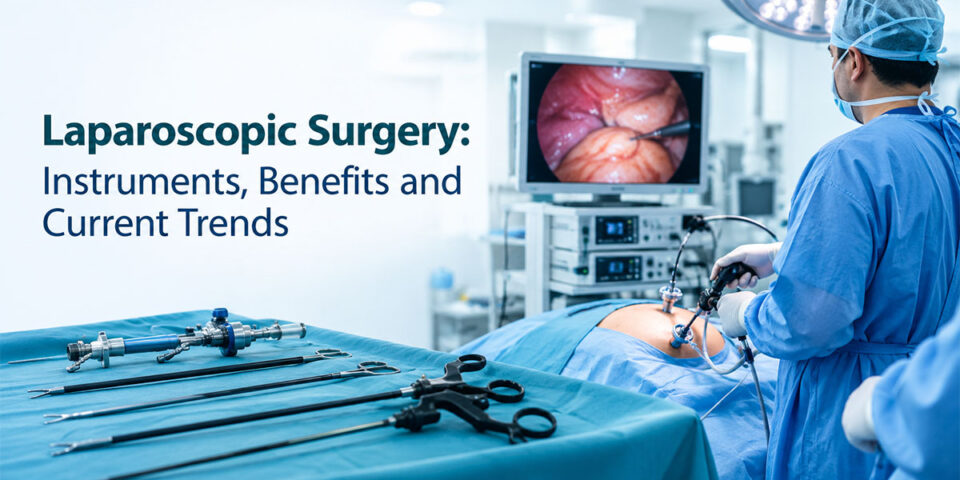
Laparoscopic surgery replaces a single large incision with several small ones, generally a few millimetres to a centimetre each, through which a camera and specialised instruments are inserted. The abdominal cavity is inflated with carbon dioxide gas to create working space, and the surgeon operates while watching a magnified, real-time video feed rather than looking directly into an open surgical field. This fundamental shift, working through small ports with a video feed instead of direct visualisation, is what demands an entirely different instrument set from conventional open surgery.
The Core Instruments a Laparoscopic Procedure Requires
A functioning laparoscopic setup depends on several categories of instruments working together:
- Trocars and cannulas, the access ports through which instruments enter the abdominal cavity, available in varying diameters depending on the procedure
- The laparoscope itself, the camera and light source providing the surgeon’s view of the surgical field
- Graspers and dissectors, used to manipulate and separate tissue with the same precision a surgeon’s hand would apply in open surgery
- Laparoscopic scissors, for cutting tissue or sutures within the confined working space
- Clip appliers, used to seal vessels or ducts before they’re divided
- Suction and irrigation instruments, keeping the surgical field clear during the procedure
- Energy-based sealing devices, increasingly standard for controlling bleeding without needing separate clips or sutures
Each of these needs to function reliably through a narrow port, which places different demands on instrument design compared to anything used in open surgery.
Why Patients and Surgeons Increasingly Prefer It
The clinical case for laparoscopic surgery has built up considerably over the past two decades, and it shows in patient preference as much as outcomes data:
- Smaller incisions mean less post-operative pain and a lower risk of wound infection
- Recovery time and hospital stay are usually shorter compared to equivalent open procedures
- Blood loss during surgery tends to be lower
- Scarring is minimal, which matters increasingly to patients weighing options for elective procedures
- Return to normal activity generally happens faster, which carries real value for working patients
This doesn’t make laparoscopic surgery the right choice for every procedure, but for the categories where it’s clinically appropriate, the advantages are substantial enough that patient demand has shifted meaningfully toward it.
Where the Field Is Trending Right Now
A few developments are actively shaping how laparoscopic surgery is practised today:
- Single-incision laparoscopic surgery (SILS), consolidating multiple ports into one, further reducing scarring for select procedures
- Robotic-assisted laparoscopic systems, offering enhanced precision and dexterity for complex procedures, though adoption remains concentrated in larger, well-resourced facilities
- High-definition and 3D imaging, improving depth perception and surgical accuracy compared to earlier flat, lower-resolution feeds
- Advanced energy devices, reducing reliance on manual clip application and cutting procedure time
- Enhanced recovery protocols, built specifically around laparoscopic patients’ faster recovery trajectory, further shortening hospital stays
Facilities keeping pace with these shifts tend to see both better outcomes and stronger patient satisfaction scores, since the technology increasingly supports faster, less invasive care across a widening range of procedures.
Instrument Quality and Reprocessing Considerations
Laparoscopic instruments face demands that open-surgery instruments don’t. Working through narrow ports repeatedly stresses joints, tips, and insulation in ways that show up as wear faster than in traditional tools if quality isn’t consistent from the outset. A few factors worth prioritising:
- Consistent calibration across identical instruments, particularly critical for energy devices where insulation integrity affects patient safety
- Durability through repeated autoclave cycles, since laparoscopic instruments typically see higher reprocessing frequency than bulkier open-surgery tools
- Compatibility between reusable and single-use components within the same procedure set, avoiding mismatched connections mid-surgery
- Verified compliance with recognised quality standards for every instrument in the set, not just the headline pieces
Cutting corners on instrument quality here carries real risk, since a failure during a laparoscopic procedure is harder to work around than in an open field with direct access and visibility.
What Hospitals Should Evaluate Before Expanding Capacity
Before committing to a laparoscopic suite expansion or upgrade, a few questions are worth working through directly:
- Which procedure types will actually be performed, since instrument sets vary considerably by specialty
- Whether existing sterile processing capacity can handle the reprocessing demands of a growing laparoscopic caseload
- Whether staff training keeps pace with any new instrumentation or energy devices being introduced
- Whether sourcing comes from a single, quality-verified supplier or several disconnected vendors, which affects consistency across procedure sets
Building a Laparoscopic Programme That Holds Up
Laparoscopic surgery isn’t simply a smaller-incision version of open surgery, it demands its own instrument logic, its own reprocessing rhythm, and its own staff training investment. Facilities that treat this as a deliberate, procedure-specific build tend to see fewer disruptions and stronger outcomes than those retrofitting equipment reactively as demand grows.
For hospitals equipping or upgrading toward laparoscopic capability, working with a supplier that also understands adjacent specialty needs matters. R.L. Hansraj & Co. has been manufacturing and supplying surgical instruments since 1927 and provides an ISO 9001:2015 certified range covering general, ENT, ophthalmic, gynecology and orthopedic categories and laparoscopic instrumentation.Orthopedic surgical instruments sourced from the same trusted provider keeps procurement consistent across departments rather than managing separate vendor relationships for every specialty a hospital supports.
That administrator staring at the quarterly numbers doesn’t need to guess at what the shift toward laparoscopic demand actually requires. With the right instrument sets, quality standards, and staff preparation in place, meeting that demand becomes a planned transition rather than a scramble triggered by patients asking for an option the facility wasn’t quite ready to offer.