
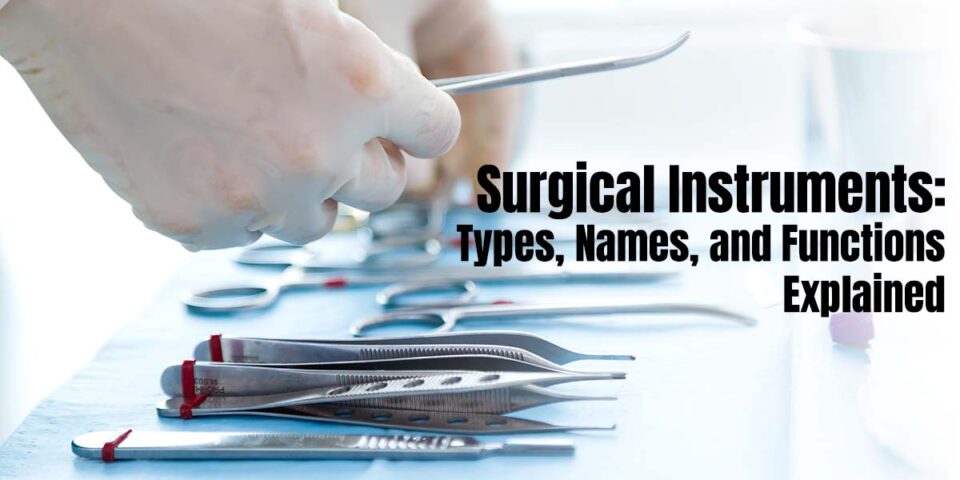
Precision in surgery doesn’t come only from training or steady hands. It begins earlier in the quality of instruments that enter the operating field. A well-balanced scalpel or a correctly weighted retractor changes how a surgeon moves, and often, how a patient heals. In orthopedics, that relationship between tool and outcome is even sharper. Reliable Orthopedic Surgical Instruments translate intent into exact motion. RL Hansraj Company has spent decades refining that link, designing and manufacturing instruments that hold their edge, their alignment, and their dependability through every procedure.
Categories of Surgical Instruments
Surgical tools are never built in isolation. Each is developed for a defined movement inside the body. When grouped, the types of surgical instruments reveal how a procedure actually works. Some are made to cut or separate tissue, others to grasp, hold, or keep an incision open.
Cutting tools usually come first in any tray: scalpels for the skin, fine scissors for tissue, and heavier ones when the muscle or fascia needs separation. After that, come the grasping instruments. Forceps, clamps, and similar pieces help the surgeon steady what they’re working on. Retractors do a different job; they pull tissue aside and hold space open so visibility stays clear. Then there are the hemostats, always close at hand to control bleeding. Suturing follows needle holders, staplers, and anything that brings the layers back together. Dilators and probes come in when there’s a cavity or channel to explore, and measuring gauges confirm that the work has been done to exact depth or alignment.
The functions of surgical instruments reflect a chain of coordination, each movement depending on another to keep the procedure accurate and safe.
Common Surgical Instruments and Their Uses
There are hundreds of types of surgical instruments, yet a small group shows up in nearly every operating setup. These are the tools that surgery can’t really happen without. Their designs haven’t changed much because the functions of surgical instruments in these categories stay the same: cutting, holding, or closing tissue with dependable accuracy. The materials may improve, the finish might get finer, but the idea behind each remains constant. That reliability is what keeps them on every instrument tray, year after year.
Most operations still start with a scalpel. Small, sharp, and steady in the hand, it sets the tone for precision that follows. Surgeons choose their blades No. 10, 11, or 15 based on the angle and depth they expect to reach. Scissors come next. Metzenbaum scissors glide through soft tissue; Mayo scissors cut heavier layers such as fascia or muscle.
Forceps extend the surgeon’s touch when fingers can’t reach. Adson and dressing forceps hold tissue without trauma, while toothed ones secure a firmer grip when the situation demands it. Hemostats take over when bleeding starts. A fine mosquito clamp slips easily into narrow spaces, while a heavier Kelly clamp is meant for thicker vessels.
Retractors do what their name implies. They ease tissue aside so the surgeon can see and move without strain. In most general procedures, a Langenbeck retractor is enough; for longer cases, a self-retaining Balfour version stays in position on its own. Needle holders serve another purpose entirely, keeping the suture needle steady when every millimeter matters. Many prefer the Mayo-Hegar or Olsen-Hegar patterns because they stay balanced even after repeated sterilization cycles.
Suction tips and speculums fill out the rest of the tray. Yankauer or Poole attachments clear fluid from the field, while dilators or speculums help open and hold passages during ENT or gynecologic work.
Each of these tools has evolved through decades of practical feedback. Small changes in curve, handle weight, or joint tension often decide how naturally an instrument feels in the surgeon’s hand.
Material and Manufacturing Precision
The lifespan of any surgical instrument begins with its material. Stainless steel remains the most trusted because it holds strength even after repeated sterilization. At RL Hansraj Company, many products use German-grade steel that undergoes strict heat treatment and passivation to resist corrosion. Surface finish isn’t cosmetic; it’s chosen for function, matte to reduce glare, satin for balanced handling, or mirror polish where easy cleaning matters more. Each instrument moves through ISO 9001:2015-certified inspection stages to confirm dimensional accuracy and alignment. The result is consistency that surgeons can feel when precision and reliability matter most.
Maintenance and Care of Surgical Instruments
Every instrument, whether for general surgery or delicate ophthalmic surgical instruments , survives on how it’s handled after use. The cleaning must start right away before fluids dry or stain the surface. Warm water, mild detergent, and a soft brush usually do the first job. After that, sterilization takes over, through autoclave or approved chemicals. Hinges need a drop of lubricant; without it, the joint stiffens over time. Bent tips or loose screws shouldn’t wait for the next case; they need correction at once. RL Hansraj Company provides inspection and servicing programs that help hospitals keep their sets dependable year after year.
Final Thoughts
Surgical precision doesn’t depend on one factor alone; it’s the outcome of well-designed tools and the skill that guides them. Each instrument, whether for general use or specialized fields like ENT surgery instruments , carries engineering that must hold steady through constant use and sterilization. Recognizing how these tools are built, maintained, and handled gives a clearer sense of their real value. RL Hansraj Company has spent nearly a century refining that standard. Hospitals that rely on our instruments invest not just in hardware, but in consistent performance and experience proven across generations of surgical practice.