
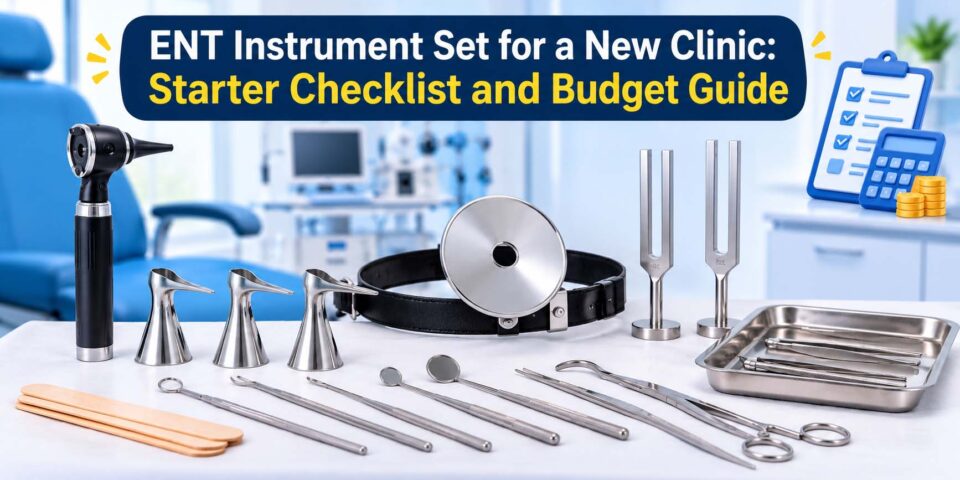
Establishing an ENT clinic involves more than securing a location and appointing staff. The instrument inventory determines which examinations and minor procedures can be performed safely and efficiently from the first day of operation, and an incomplete or poorly chosen set can delay both.
This guide presents a structured starter checklist, divides instruments into essential and later-stage categories, outlines budget priorities, sets out quality and sterilisation considerations and offers advice on working with a supplier. Practitioners comparing medical tools for surgery will find it useful for planning a purchase that is both complete and economical.
Defining the Scope of the Clinic First
The instruments you need depend on the services you intend to offer. A clinic limited to consultation, examination and simple office procedures requires a smaller set than one performing minor surgery, endoscopy or day-care procedures. Before preparing a list, decide whether the clinic will focus on adult care, paediatric care or both, and which procedures will be performed on site, such as wax removal, nasal packing, foreign body removal or biopsy. Consider whether minor operations under local anaesthesia will be offered, and whether endoscopy or audiology services are planned within the first year.
Patient volume affects quantity as well as type. A busy clinic needs multiple sets, so that instruments can be sterilised and rotated without delay.
The Essential Examination Set
Every ENT clinic requires a core group of instruments for routine assessment. These items are used daily and should be the first purchases.
- Head mirror or headlight: Provides focused illumination for examination
- Otoscope: For viewing the ear canal and tympanic membrane, ideally with a range of speculum sizes
- Ear specula: Reusable sets in assorted sizes, or disposable alternatives
- Nasal specula: Such as Thudichum or Killian types, for anterior rhinoscopy
- Tongue depressors: Disposable or reusable
- Tuning forks: Typically 512 Hz and 256 Hz for basic hearing tests
- Laryngeal mirrors: In several sizes, with a means of warming or anti-fog treatment
- Bayonet forceps and ear forceps: For handling and removal of debris
- Jobson Horne probe: For wax removal and cleaning
- Suction apparatus and tips: For clearing secretions and debris
These instruments form the basis of daily practice, and reliable quality in this group matters more than extras.
Instruments for Minor Procedures
Once the examination set is in place, a second group supports common office procedures.
Common additions include ear syringes and wax removal tools, nasal cautery equipment and packing forceps, tonsil-holding and biopsy forceps for appropriate procedures, and punch and cup forceps for sampling. Small scissors, dressing forceps, artery forceps and needle holders are needed for minor surgical work. Foreign body hooks and probes for the ear and nose are essential in many clinics, and a set of Eustachian catheters or similar items may be relevant depending on practice.
Keep duplicates of the most frequently used items, since one set will always be in sterilisation while another is in use.
Endoscopy and Advanced Equipment
Many clinics now include nasal endoscopy as part of routine diagnosis. A rigid or flexible endoscope, a light source and a camera or display provide a clearer view than traditional methods, and they allow documentation and patient education.
This equipment represents a larger investment, so it is often planned as a second-phase purchase once patient volume is established. If you intend to include it from the start, confirm compatibility between scopes, light sources and cameras, and ask about maintenance, repair arrangements and cleaning protocols. Endoscopes require careful reprocessing and cannot be treated like simple metal instruments.
Sterilisation and Infection Control Essentials
Instruments are only as safe as the process that cleans them, so budget for sterilisation equipment and supplies alongside the instruments themselves. At a minimum, the clinic needs an autoclave sized to its volume, with suitable pouches or trays, and an ultrasonic cleaner for removing debris from fine instruments.
Enzymatic detergents and disinfectants suited to the materials in use, together with trays, pouches, indicator tapes and storage containers, complete the supplies. Separate areas for dirty and clean handling prevent cross-contamination, and a logging system records each sterilisation cycle.
Choose instruments that tolerate repeated autoclaving without corrosion or loss of function. Staff should be trained in cleaning, packing and loading, since proper process matters as much as the equipment.
Quality Checks Before You Buy
Instrument quality affects durability, precision and patient safety, and a few inspections reveal a great deal. Examine the material first, preferably surgical-grade stainless steel with a smooth, even finish. Check that hinges, locks and ratchets work smoothly and firmly, and do not wobble. Be sure tips, jaws and edges are clean and free of burrs. Look for clear markings that identify size, type and manufacturer, confirm that the serrations on forceps meet evenly and ask for documentation covering material and manufacturing standards.
If possible, handle samples before ordering in bulk. Instruments that feel balanced and move smoothly in the hand usually perform better in practice.
Building a Realistic Budget
Avoid spending the entire budget on a long list of rarely used instruments. A sensible allocation follows priorities.
A suggested approach is to invest first in the essential examination set and sterilisation equipment, since these are required from the first day. Then budget for a moderate selection of minor procedure instruments, with duplicates for high-use items. Reserve a portion for replacements and for additions as the practice grows, and treat endoscopic equipment as a separate planned expense.
Request itemised quotations and compare them on the same basis, including brand, grade, warranty and delivery. Prices vary widely depending on origin and quality, so a very low quotation for a precision instrument deserves scrutiny. Consider total cost of ownership, since a durable instrument that lasts years usually costs less than frequent replacements.
Selecting a Supplier and Planning for the Long Term
A supplier should be judged on more than price. Look for a clear product range, consistent quality from order to order, reliable stock, prompt delivery and responsive after sales support. Ask about return and replacement policies, repair or reconditioning services and the availability of spares.
R L Hansraj Company is involved in the supply of surgical and medical instruments to hospitals, clinics and dealers. The product lines of the company include specialist categories like ENT. Its catalogue is organised so that buyers can review instruments by specialty and match them to the procedures planned.
Place a test order, check the quality and the service, then increase the order once you’re sure. Maintain a register of instruments, with purchase dates and sterilisation counts, so that replacements can be planned before failure.
Completing the Starter Set With Confidence
A new ENT clinic is best served by a deliberate, phased approach: an essential examination set first, minor procedure instruments next, advanced equipment later and sterilisation resources throughout. Quality checks, itemised budgets and a dependable supplier turn a long list into a manageable plan. When you are ready to review specific items and specifications, the range of Ent surgery instruments offers a practical starting point for building the set.