
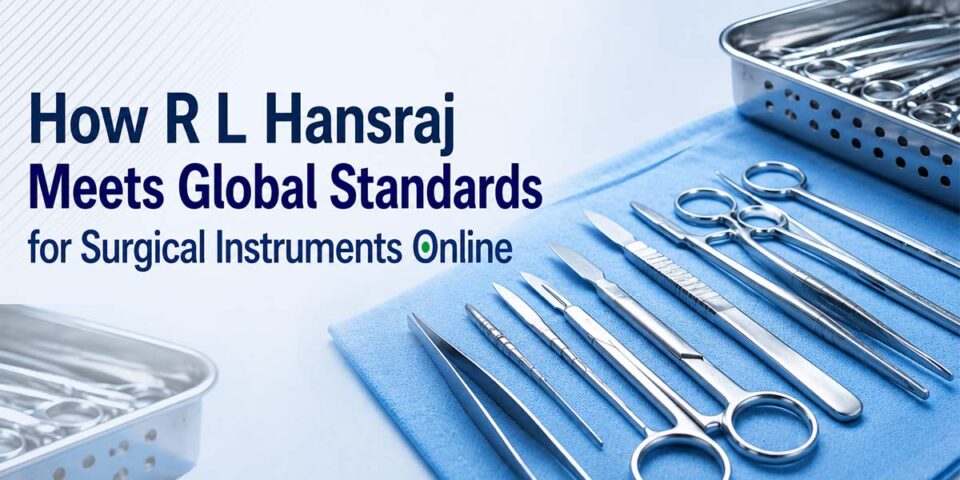
There’s a particular kind of hesitation that comes with buying medical tools for surgery online. You can’t hold the instrument, can’t feel whether the balance is right in your hand, can’t check the edge yourself before it arrives at your clinic or operating theatre. And in this field, that hesitation is justified.
A forceps that’s slightly misaligned, a scissor that doesn’t hold its edge, a scalpel with uneven weight distribution. These aren’t cosmetic issues. They can really affect how a procedure goes. So the question buyers should be asking isn’t just “does this look professional,” but “what standards is this supplier actually held to.” R.L. Hansraj & Co. has spent close to a century answering that question the hard way, through consistency rather than claims.
Nine Decades in the Business
Founded in 1927, R.L. Hansraj has been in this business long enough to have predated most of the formal quality frameworks that now govern the industry. That’s worth sitting with for a moment. Staying operational for nine decades, and doing so while earning repeat business from hospitals, government institutions, medical colleges, and private practices, isn’t something that happens through luck or good marketing. It happens because the fundamentals hold up, order after order, decade after decade.
Along the way, the company has had to keep reinventing parts of itself. Surgical practice has changed enormously since the 1920s, and even in recent decades the shift toward minimally invasive procedures has forced instrument makers to rethink designs that once seemed settled.
R.L. Hansraj has stayed in step with that, upgrading facilities, adopting newer metallurgical standards, and treating quality control as something built into the process rather than bolted on at the end. It’s less a supplier relationship and more something closer to a long-term partnership with the institutions it works with.
What ISO 9001:2015 Actually Means in Practice
It’s easy to be cynical about certifications. A lot of them amount to a framed document and not much else. ISO 9001:2015 isn’t one of those, at least not the way R.L. Hansraj applies it, because it comes with recurring audits that check whether standards are actually being met, not just claimed. In practical terms, that looks like:
- Standardized production, so an instrument ordered today matches the specs of one ordered two years ago. No drift, no quiet substitutions.
- Regular audits, internal and third-party both, that keep checking the work long after the initial certification was granted.
- Raw material verification, meaning the alloys going into these instruments are tested for composition and strength before anything gets manufactured.
- Multi-stage inspection, catching problems in alignment, sharpness, or finish before an instrument ever leaves the facility.
None of this is about the paperwork. It’s about not leaving quality to chance, or to whoever happens to be checking that day. The system is designed to catch mistakes on its own.
Built to Survive Sterilization, Cycle After Cycle
Surgical instruments get put through a lot. Repeated autoclave cycles, harsh cleaning agents, constant handling. That’s why R.L. Hansraj builds its general, ENT, and ophthalmic lines from surgical-grade stainless steel, and turns to titanium and other biocompatible materials for more demanding orthopedic applications.
| What matters | Why |
| Corrosion resistance | Keeps pitting and rust from creeping in after repeated sterilization |
| Edge retention | Blades and scissors stay sharp instead of dulling quickly |
| Dimensional uniformity | A replacement part performs exactly like the original |
| Ergonomic design | Less strain on the hand during long procedures |
Here’s the thing about these four factors: they don’t operate independently. An instrument can resist corrosion beautifully and still be a poor tool if it dulls fast. Something can be razor sharp and still cause fatigue if it’s poorly balanced.
Getting all four right, consistently, across every batch, is a harder problem than it sounds, and it’s usually where cheaper alternatives quietly fail even though they look fine sitting in a display case.
A Catalog Built for Every Specialty
The same standards carry through everything R.L. Hansraj makes, across a wide range of specialties:
- Ophthalmology: Instrument sets for cataract, glaucoma, squint, and enucleation procedures, built for the kind of precision eye surgery leaves no room to compromise on.
- ENT & Gynecology: O.P. instruments, tonsillectomy and septoplasty sets, FESS and micro-laryngeal tools, along with dilators, uterine sounds, forceps, and speculums.
- Orthopedics & Neurology: Bone saws, drill bits, plate benders, hexagonal screwdrivers, retractors, and rongeurs for spinal and cranial work.
- Cardiovascular & Laparoscopy: Vascular clamps, high-grade suture needles, fine scissors for delicate vascular work, trocars, and endoscopic graspers.
Beyond instruments, there’s also hospital furniture, tungsten carbide tools, and a broader range of healthcare products, which means an institution can realistically cover most of what it needs from one supplier instead of managing five different vendor relationships.
In orthopedics specifically, the catalog runs from simple, inexpensive items like gigli saw wire all the way up to specialized fixation and bone-holding equipment, so a surgical team can build out a complete set without hunting elsewhere.
Sourcing That Doesn’t Ask You to Just Trust It
Online procurement only works when the supplier is genuinely transparent, not just about pricing but about specifications and certifications too. R.L. Hansraj publishes its technical details openly, offers real support through email and WhatsApp, and manages bulk orders for hospitals, clinics, and medical colleges through a proper inquiry process. That last part matters more than it might seem for institutional buyers, who usually need to lock in pricing and delivery windows well before instruments are actually needed on the ground.
There’s also a 10 percent discount for medical students, available once they verify their student or college ID over WhatsApp. It’s a small gesture, but it says something about intent: building relationships with practitioners early, before they’re established, rather than only once they’ve become a big account.
Warranty and maintenance support round things out, and it matters more for higher-investment purchases like ENT equipment, where what happens after the sale is often just as important as what happens during it.
For anyone searching for reliable surgical shops in Chennai, an ISO 9001:2015-certified manufacturer that still answers the phone after the invoice is paid is really the baseline worth insisting on, not a bonus.
Frequently Asked Questions
How does R.L. Hansraj ensure surgical instrument quality online?
R.L. Hansraj ensures quality of surgical instruments online by following ISO 9001:2015 standards, using surgical-grade stainless steel and titanium parts and inspecting at every stage of production from the raw material inspection to the final sign-off.
Which medical specialties does R.L. Hansraj manufacture instruments for?
General surgery, ENT, ophthalmology, orthopedics, gynecology, neurology, cardiovascular, and laparoscopic procedures, plus hospital furniture and broader healthcare products.
Can healthcare facilities place bulk orders with R.L. Hansraj?
Yes, through a dedicated inquiry process or directly over WhatsApp.
Does R.L. Hansraj offer discounts for medical students?
Yes, medical students who have verified their student or college ID over WhatsApp prior to placing their order will receive a 10 percent discount.
Are these instruments built to survive repeated autoclaving?
Yes. The stainless steel and biocompatible materials used are made to handle thousands of sterilization cycles without losing sharpness or structural integrity.
What happens if an instrument arrives damaged or fails under warranty?
Customer service will take care of the repair or replacement depending on the problem, so the institution doesn’t have to eat the cost of a manufacturing defect alone.