
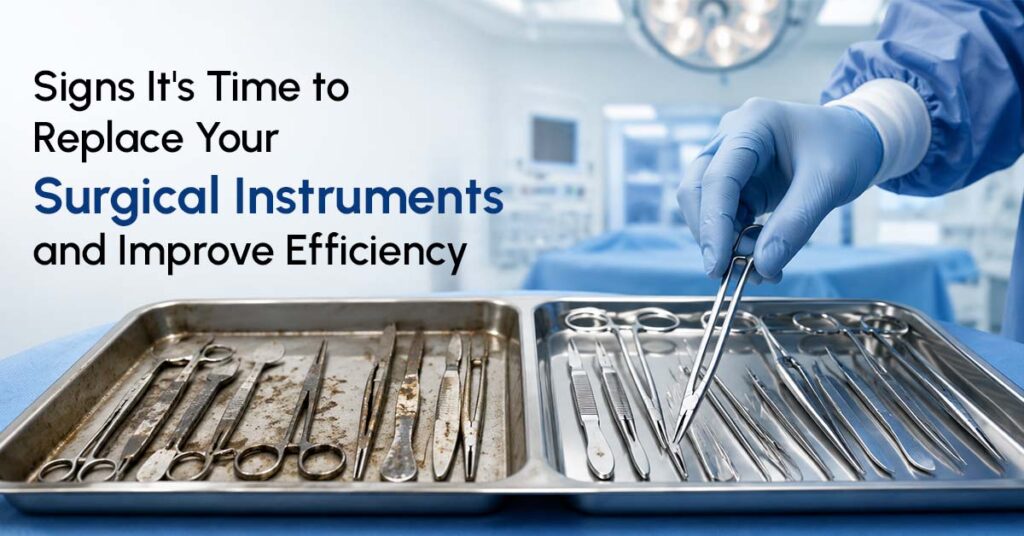
A pair of scissors that used to cut cleanly now catches on tissue halfway through. A forceps grip that once felt tight now slips just slightly under pressure. None of this shows up as a dramatic failure. It shows up as small, quiet friction, the kind that adds a few extra seconds to a procedure here and there, until those seconds start adding up across an entire surgical day.
Most hospitals do not replace instruments on a fixed schedule. They replace them when something finally forces the issue, often after a near miss rather than before one. Working with dependable surgical instruments suppliers early, before instruments fail mid procedure, is what actually protects both patient safety and surgical efficiency.
Visible Wear Is Rarely the First Sign
By the time damage is obvious to the eye, an instrument has usually already been underperforming for a while. Corrosion spots, pitting, or discoloration on stainless steel are late stage signs, not early ones. The earlier signs are far more subtle, a scalpel that needs slightly more pressure to make the same cut, a needle holder that no longer locks with the same firm click it once had.
Surgical staff often adapt to this gradual decline without realising it, compensating with small adjustments in technique. That adaptation hides the problem instead of solving it, and it usually continues right up until the instrument fails at a genuinely inconvenient moment.
Cutting Instruments That Have Lost Their Edge
Scalpels, scissors, and other cutting tools are usually the first to show real wear, since they take the most direct mechanical stress during use. A dull blade does not just slow down a procedure. It forces surgeons to apply more pressure than intended, which increases the risk of tissue trauma and makes precise, clean incisions harder to achieve.
Repeated sharpening prolongs the life of the blade to a certain extent, but with each sharpening cycle material is removed and eventually the blade geometry itself begins to change. There is no amount of sharpening at this point that will restore the original performance and replacement is the only real option.
Joints, hinges and locking mechanisms Wear down
Forceps, needle holders and other hinged instruments rely on tight, precise joints to work correctly. Over time and with repeated sterilization cycles, these joints can loosen, develop play or fail to lock securely. A needle holder that does not hold firmly is not a minor inconvenience, it directly affects control during suturing, where precision matters most.
Stiffness is just as telling as looseness. An instrument that used to open and close smoothly but now feels gritty or resistant is usually signaling internal wear that cleaning alone will not fix.
Instruments That No Longer Sterilize Properly
Pitting, surface scratches, and micro cracks do more than affect appearance. They create tiny spaces where residue and bacteria can hide, making full sterilization genuinely harder to guarantee, no matter how carefully the autoclave cycle is run. This is one of the more serious signs to watch for, since it moves beyond inconvenience into a direct infection control concern.
Instruments that consistently show staining after sterilization, or develop a rough texture that was not there before, should be flagged for replacement rather than kept in rotation on the assumption that another cleaning cycle will resolve it.
The Hidden Cost of Compensating for Worn Tools
One of the clearest practical signs is time. If a procedure that used to take a predictable amount of time keeps running longer, and the surgical team keeps mentioning the same instrument as the reason, that is worth taking seriously. Worn tools do not just underperform individually, they slow down the entire rhythm of a procedure, since surgeons often work around a faulty instrument rather than through it.
This kind of inefficiency is easy to overlook because it builds up gradually rather than appearing all at once. But across a full day of procedures, a few extra minutes per case adds up to real lost time, and real added strain on surgical staff.
Making Replacement a Planned Decision, Not a Reaction
Waiting for an instrument to fail mid procedure is the most expensive way to handle replacement, both financially and in terms of risk. A better approach is routine inspection, checking cutting edges, joint tension, and surface condition on a regular basis, and replacing instruments proactively once early signs appear, rather than after they have already caused a delay or a complication.
Reliable sourcing is what makes this proactive approach possible. A hospital already connected with R.L Hansraj & Co. Surgicals, one of the established surgical instruments manufacturers in Chennai supplying hospitals and clinics across Bangalore and Coimbatore as well, can replace a failing instrument within days, not weeks, instead of scrambling to find a dependable supplier only after a procedure has already been disrupted.
Efficiency Starts With Equipment You Can Trust
Surgical efficiency depends on instruments that perform exactly the way they are supposed to, every single time, without forcing a surgeon to compensate for wear that should have been caught earlier. Recognising these signs early, before they turn into a delay or a safety issue, is what actually protects both patients and surgical schedules. Sourcing dependable instruments consistently is not an added cost, it is what keeps an operating room running the way it is supposed to.
For hospitals and clinics looking to replace worn instruments with reliable, precision made alternatives, R.L Hansraj brings years of manufacturing experience to every instrument it produces, built for exactly this kind of consistent, everyday performance.